

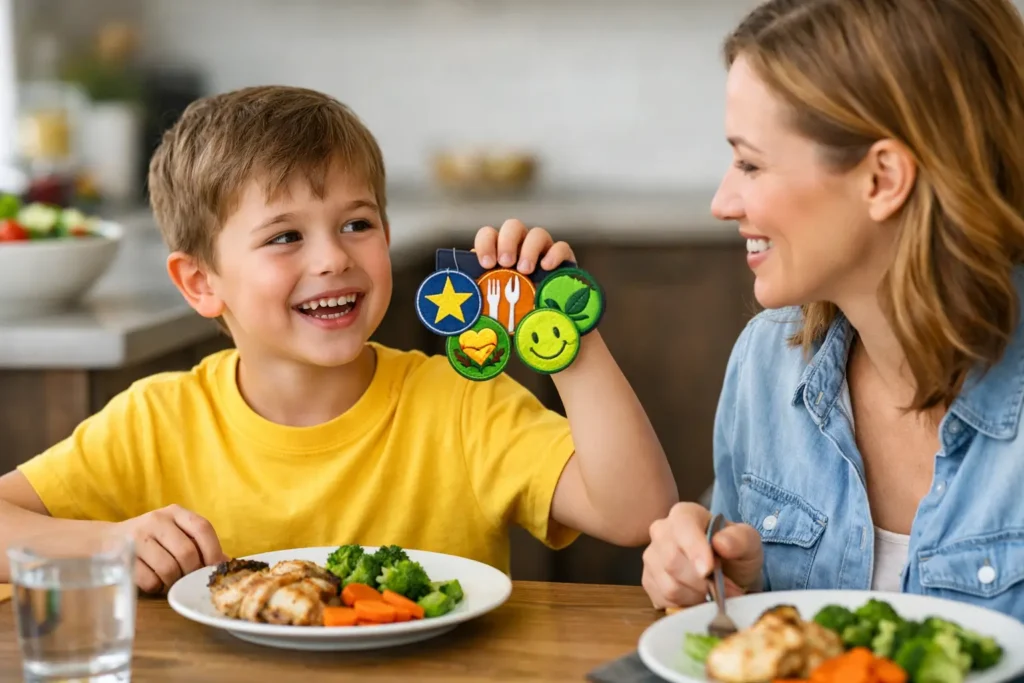
Your child just touched a green bean to their lips after rejecting it for weeks. It may not look like a big breakthrough from across the table, but you know better. For a picky eater, that tiny moment can be real progress. So, should kids earn badges for moments like this? For many families, a small celebration can make trying food feel safer, more fun, and far less like a showdown.
The key is what the badge means. A badge should not say, “Eat everything on your plate or you win.” It should say, “You were brave enough to try.” That difference can change the whole mood of dinner.
Why badges can work for picky eaters
Young children are wired for play, progress, and little moments of recognition. They love seeing that their actions lead somewhere: one bite reveals more of a picture, a new food earns a colorful badge, or a brave taste gets a happy celebration. These small signals can turn a food they fear into a manageable challenge.
For a child who is nervous about unfamiliar textures, smells, or colors, “Try three bites of broccoli” can feel huge. A bite-by-bite game makes the job feel smaller. One bite is just one bite. Then they get to see what happens next.
Badges also give parents something positive to notice. Instead of repeating, “Please just eat,” you can say, “You took a brave bite. Look what you earned.” The focus shifts away from what your child refuses and toward what they are learning to do.
That matters because picky eating is rarely solved by more pressure. Kids who feel watched, forced, or criticized often become even more determined to avoid the food. Playful encouragement gives them room to participate without turning the table into a power struggle.
Should kids earn badges for eating every bite?
Usually, no. A badge system works best when it celebrates effort, not a clean plate.
Children have different appetites from day to day. They may be growing, tired, distracted, coming down with a cold, or simply full. Asking them to eat past their hunger cues just to earn a reward can send the wrong message. The goal is not to teach children to ignore their bodies. The goal is to help them feel more comfortable around food.
Instead, create badges around behaviors you actually want to encourage: sitting with a new food nearby, smelling it, touching it, licking it, taking one taste, or trying a bite without a big fight. These are all meaningful steps, especially for kids ages 2 to 8.
A child does not need to love zucchini after one try for dinner to count as a win. They may need to see it many times before they are ready to taste it. A badge can make those repeat exposures feel like a game rather than a test.
The difference between a badge and a bribe
Parents are right to be cautious about rewards. Most of us have seen the deal go sideways: “Eat your carrots and then you can have dessert.” Suddenly, carrots become the terrible obstacle standing between your child and the thing they really want.
That is a bribe. It puts food in competition with something more exciting and can accidentally make the meal feel transactional.
A badge is different when it is built into the experience of trying. It is immediate, lighthearted, and connected to the behavior itself. Your child takes a bite, makes progress in a game, sees a surprise appear, and gets a cheerful moment of recognition. There is no bargaining, no dangling treat, and no need to negotiate for five more bites.
Think of it like cheering at the playground. You are not paying your child to go down the slide. You are acknowledging their courage when they try something that felt a little scary.
Keep the goal small enough to succeed
A badge system can backfire if the goal is too hard. If your child has not eaten a crunchy vegetable in months, a badge for finishing a bowl of salad may feel impossible. When kids believe they cannot win, they often stop playing.
Start where your child is. For one child, the first badge might be for keeping peas on the plate. For another, it could be for tasting a new sauce. If they already eat a few bites comfortably, you might celebrate trying a food in a different shape, color, or preparation.
Use language that makes room for choice. “Would you like to earn your brave taste badge with a tiny bite or a medium bite?” can feel much better than “You have to eat this.” You are still offering structure, but your child has a little control inside it.
It also helps to let the badge come quickly. Young children live very much in the present. Waiting until the end of the week for a prize board may not mean much to a preschooler. A visual reveal, animation, or badge that appears right after the bite makes the connection clear and satisfying.
Make badges part of a calmer table routine
Badges are most helpful when they support a routine, not when they become the whole dinner. Serve at least one familiar food alongside anything new. Keep portions of new foods small. Avoid making dramatic announcements about the “special healthy food” everyone must eat.
Then introduce the game with a calm, cheerful tone. You might say, “There’s a surprise waiting after each brave bite,” and leave it there. No speeches. No threats. No chasing your child around with a fork.
If they say no, stay neutral. “That’s okay. It can stay on your plate.” Your child may be more willing to try later when they realize that saying no does not bring a lecture.
This is where a tool like Easy Eaters can be useful. It turns each bite into visible progress, with image reveals and badges that give kids a reason to stay curious at the table. For parents, it offers something even more valuable: fewer tense negotiations and more chances to celebrate the small wins that often lead to bigger changes.
When badges may not be the right answer
Badges are not magic, and they are not necessary for every child. Some kids are naturally interested in food and do not need extra motivation. Others may get so focused on earning the badge that they lose touch with whether they are hungry or comfortable. If that happens, simplify the game or take a break from it.
You should also consider extra support if your child regularly gags, chokes, avoids entire food textures, loses weight, has pain while eating, or becomes extremely distressed around meals. Those signs can be more than everyday picky eating, and a pediatrician or qualified feeding professional can help you understand what is going on.
For ordinary food refusal, though, a badge can be a gentle bridge. It gives a child a reason to take the next small step without demanding that they become an adventurous eater overnight.
Let progress be the prize
The best mealtime badge is not one your child earns by being perfect. It is one that reminds them, “I can try hard things.” Maybe tonight that means a sniff of a strawberry, one lick of hummus, or a tiny bite of chicken that would have caused tears last month.
Notice it. Celebrate it. Then let the meal move on. A peaceful table and a child who feels proud of one brave bite are both worth more than an empty plate.