

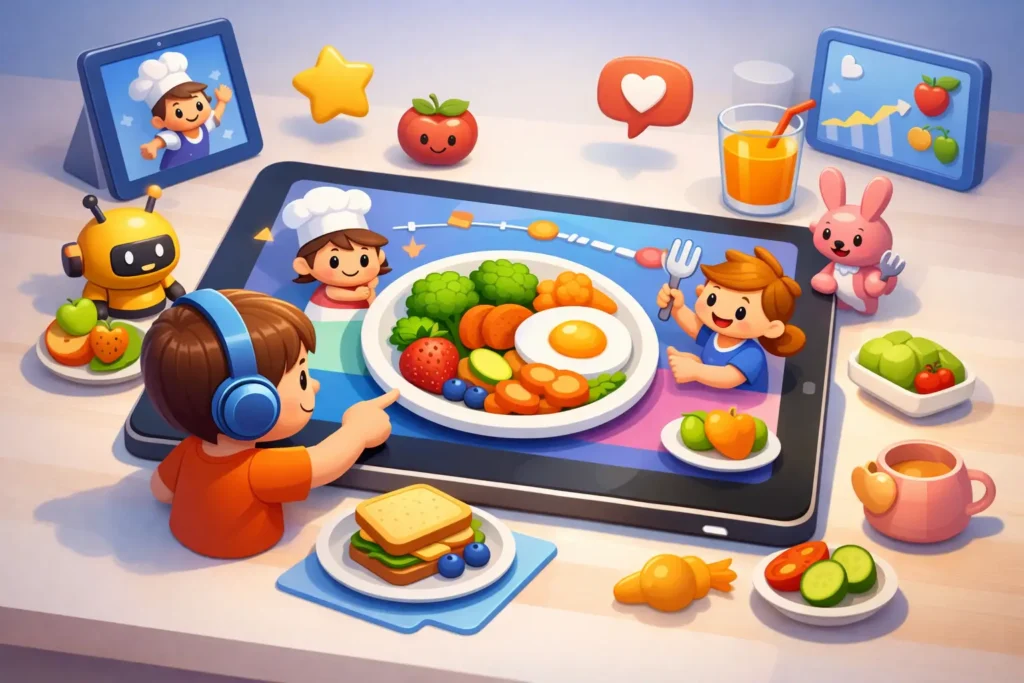
The broccoli is still on the plate. Your child has already said “no” three times. You are doing the mental math on whether one more request will lead to a bite, a meltdown, or another dinner nobody enjoys. For many families, an interactive eating app for children can change that familiar moment by giving kids something more inviting to focus on than the food they are unsure about.
Instead of turning every bite into a negotiation, a well-designed app makes participation feel playful. A bite reveals part of a picture, moves a progress bar forward, earns a badge, or triggers a small celebration. The food does not suddenly become their favorite. But the mood around it can become much lighter.
Why picky eating can turn dinner into a daily standoff
Picky eating is rarely just about a child being difficult. Young children are still learning what unfamiliar tastes, smells, colors, and textures feel like. A green bean may look suspicious. A mixed casserole may feel unpredictable. Even a food they liked last week can be rejected because it is cut differently today.
Parents are often caught in the middle. You want your child to eat enough, try new foods, and build healthy habits. At the same time, you do not want dinner to become a place of pressure, pleading, threats, or separate meals every night.
That is why traditional tactics can backfire. Repeatedly saying “just one bite” can make the bite feel bigger and more stressful. Offering dessert as a reward may work in the moment, but it can also teach children that dinner is a hurdle standing between them and the food they really want. For some children, a sticker chart is exciting for a day or two, then forgotten in a kitchen drawer.
What many families need is not another rigid plan. They need a simple reset they can use right at the table.
How an interactive eating app for children changes the moment
The best interactive eating tools are not about forcing children to clean their plates. They create a positive reason to take a small step. That might mean tasting a food, taking a bite of a familiar meal, or returning to the table after they have started to resist.
The key is that progress is visible. Children can see that each bite does something. A hidden image becomes clearer. A character gets closer to a goal. A cheerful animation celebrates effort. Those tiny moments of feedback can feel much more meaningful to a young child than a parent saying, “Good job,” for the tenth time.
This approach works because it moves the spotlight. Rather than staring at the peas and wondering whether they have to eat them, your child is curious about what will appear next. The app does not remove food preferences or sensory sensitivities, and it should not pretend to. It simply gives children a low-pressure way to practice.
For parents, that shift can be a relief. You can offer the meal, start the game, and let the experience carry some of the encouragement. You are still present and supportive, but you are no longer required to be the negotiator, entertainer, and referee all at once.
What makes the experience feel encouraging, not controlling
Not every food game is equally helpful. A good app should feel like an invitation, not a digital version of “you cannot leave until you eat.” The difference matters.
It rewards participation, not perfection
A child does not need to eat every item on the plate for a mealtime to count as progress. One bite may be a big deal for a child who normally refuses a food without touching it. A playful app gives that small win a moment to shine.
That does not mean you must celebrate every bite with huge excitement. Some children enjoy big cheers; others find them overwhelming or performative. Keep your response warm and calm: “You did it. You tried.” Then let the game provide the sparkle.
It keeps the goal small and clear
Young children respond best to goals they can understand. “Let’s see what happens after three bites” is clearer than “You need to eat a healthy dinner.” It also avoids turning the entire plate into an impossible-looking task.
Small goals can be especially useful with new foods. You might serve one familiar food alongside the new item, then use the app to make trying feel manageable. If your child is not ready to bite, smelling, touching, or licking may be the next step. Progress is not always linear, and that is okay.
It does not replace connection at the table
The phone or tablet should support the meal, not take it over. Use it briefly between bites, then look up, talk, laugh, and eat together. If the screen becomes the only way your child can eat, scale back and make the game a special mealtime helper rather than the main event.
For most families, a few short moments of interaction are enough. The app gives the child a reason to engage, while the family still gets to have dinner.
A practical way to start tonight
Start with a meal that already feels fairly safe. This is not the night to introduce a plate full of unfamiliar foods and expect a miracle. Include at least one food your child usually accepts, then add a small portion of something they are practicing.
Before the meal, set a friendly expectation. You might say, “We are going to play a bite game tonight. Every time you take a bite, you get to see more of the surprise.” Keep your voice light. Do not frame the game as a test or a consequence.
Choose a realistic number of bites based on your child and the meal. Three bites may be plenty for a hesitant eater. If your child is happily participating, you can continue, but resist moving the goalposts halfway through. Children notice when “three bites” unexpectedly becomes “five more.”
When they take a bite, let the app respond. Then give a simple acknowledgment and move on. Avoid asking, “Did you like it?” immediately after every try. That question can create pressure to deliver a verdict. A more useful response is, “You were willing to try it,” or “You noticed the crunchy part.”
If your child says no, stay calm. You can offer the next chance later in the meal, but do not turn refusal into a showdown. The goal is to make food feel less loaded over time, not to win one difficult dinner.
When an app may be especially useful
An interactive tool can be helpful when your child gets stuck in a pattern of refusing before tasting, needs a predictable routine, or responds strongly to visual play. It can also help during those tiring phases when every meal seems to bring the same argument and you need a new script.
Easy Eaters is built for exactly these everyday moments, using bite-based image reveals, badges, and celebrations to turn progress into a game. It is not a meal plan or a strict feeding system. It is a simple tool for helping families move from “Please just eat” to “Let’s see what happens next.”
Still, an app is not the right answer for every situation. If your child has significant trouble chewing or swallowing, extreme anxiety around food, weight loss, pain while eating, or an increasingly narrow range of accepted foods, talk with your pediatrician or a qualified feeding professional. Playful encouragement can support healthy practice, but it cannot replace personalized clinical care when there is a deeper concern.
The habits around the game matter, too
An app works best alongside a calm mealtime rhythm. Serve regular meals and snacks, give your child enough time to eat, and try to sit together when you can. You do not need picture-perfect family dinners. Even ten peaceful minutes is a meaningful start.
Offer food without making separate demands for each item. Your job is to decide what is available and when it is served. Your child can listen to their hunger and decide whether and how much to eat. The game can encourage a try, but it should not override fullness.
It also helps to keep language neutral. Instead of calling food “good,” “bad,” “naughty,” or “yucky,” describe what is real: warm, cold, soft, crispy, sweet, or tangy. Curiosity is easier to build when a child does not feel judged for having a strong reaction.
Most importantly, allow repetition. A child may need many relaxed exposures before a new food feels familiar. A few bites this week, a refusal next week, and another try later can still add up to real growth.
Dinner does not have to be the place where everyone runs out of patience. Start with one small, playful goal, keep the pressure low, and let your child discover that trying can feel like a win.