

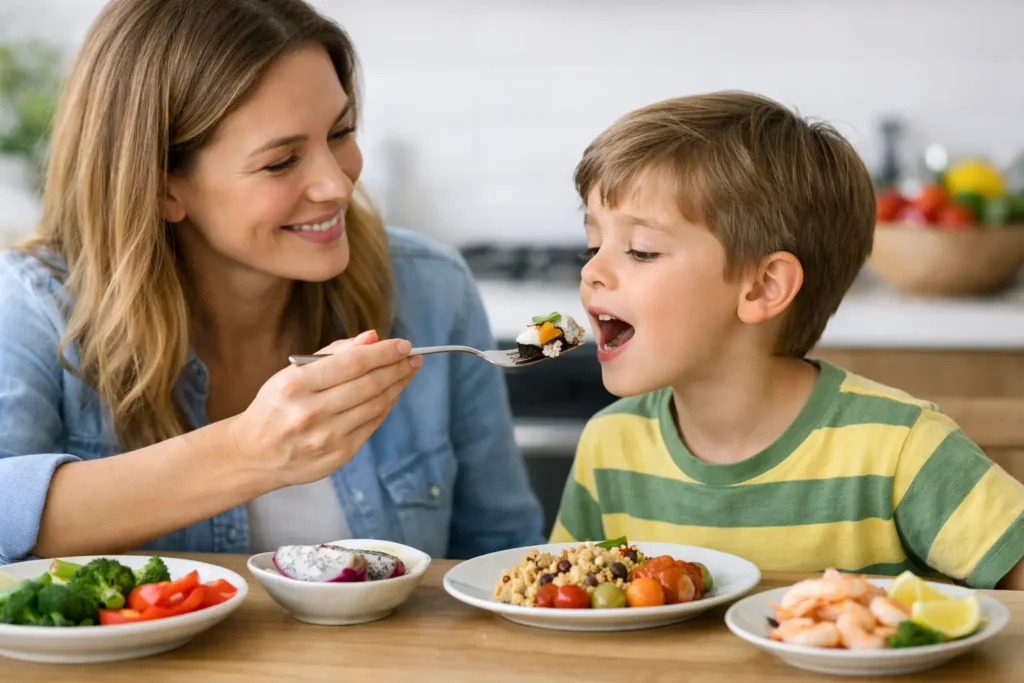
The broccoli has been sitting on the plate for 20 minutes. Your child has negotiated, frowned at it, and asked for crackers twice. It is tempting to plead for one bite just to move dinner along. But when you teach adventurous eating, the real goal is bigger than getting broccoli eaten tonight. You are helping your child learn that unfamiliar food can be safe, interesting, and worth trying.
That shift takes pressure off everyone. Adventurous eating is not about raising a tiny food critic or expecting a child to love every meal. It is about building comfort through small, repeatable moments: looking at a food, touching it, smelling it, licking it, or taking a tiny bite. Those moments count.
Start With a Calm, Low-Stakes Table
Kids are much more likely to explore food when dinner does not feel like a test. If every new item arrives with, “You have to try this,” it can quickly become the most powerful thing on the plate – and not in a good way.
Serve one familiar food alongside a small portion of something less familiar. The familiar food gives your child an easy place to begin, while the new food gets a regular, relaxed invitation to belong at the table. A single pea, one shred of chicken, or a tiny spoonful of sauce is enough. Big portions can feel overwhelming and create more waste.
Then keep your language light. Instead of asking, “Are you going to eat it?” try, “This carrot is super orange and crunchy,” or, “I wonder if this mango feels slippery or squishy.” You are inviting curiosity, not demanding a performance.
Let progress look small
A child who touches a strawberry after refusing it for weeks is making progress. So is a child who puts a noodle in their mouth and takes it back out. These are not failures or bad manners when they are part of learning.
Try to avoid moving the finish line. If you say one bite is enough, let one bite be enough. When children trust that their effort will be respected, they are less likely to dig in their heels next time.
Make Trying Food Feel Like Play
For young children, play is not a distraction from learning. It is often how learning happens. A serious conversation about nutrition may not persuade a 4-year-old, but a silly taste test just might.
Give the food a role in a game. Can your child make a “crunch sound” with a cucumber? Can they find the sweetest berry? Does the potato look more like a moon, a cloud, or a dinosaur egg? You can compare colors, count peas, make a rainbow plate, or vote on whether a food is crunchy, soft, sweet, tangy, or plain weird.
The key is to keep the game focused on exploration, not on winning by clearing a plate. A child can earn a smile, praise, or a fun moment for being brave enough to interact with food at any level. That is very different from using dessert, screens, or toys as payment for eating.
Easy Eaters can bring that same playful energy right to the table, turning bites into image reveals, badges, and small celebrations that make trying food feel more like a game than a showdown.
Teach Adventurous Eating With Tiny Steps
Some children can take a bite of a new food quickly. Others need many calm exposures before they are ready. Neither approach is wrong. The best pace is the one that helps your child stay curious instead of overwhelmed.
Think of food exploration as a ladder. Your child may start by tolerating a new food on the table. Next, they might help put it on a plate, touch it with a fork, smell it, or give it a kiss. Eventually, they may lick it, nibble it, chew it, and swallow it.
You do not need to announce this ladder at dinner. Just notice where your child is today and offer the next smallest step. If mushrooms feel impossible, asking them to take a full bite may spark a battle. Asking whether they want to touch a mushroom with one finger can feel manageable.
Keep new foods familiar enough
A new food does not have to arrive alone. Pair it with a favorite dip, serve it beside a trusted carb, or prepare it in a shape your child already likes. A child who rejects roasted sweet potato may be curious about a thin, crispy sweet potato fry. A child who dislikes plain yogurt may accept a tiny swirl next to fruit.
This is not trickery. You are creating a bridge between what feels safe and what feels new. Over time, that bridge can get longer.
Give Kids a Little Control
Picky eating often gets more intense when children feel powerless. You are still the parent setting the menu, but offering small choices can reduce the urge to fight.
Let your child choose between two vegetables, pick which plate to use, sprinkle cheese, stir the sauce, or decide whether the new food goes beside the rice or in a separate little bowl. Even helping rinse blueberries or tear lettuce can make a food feel less foreign.
At the table, offer choices that both work for you. “Would you like to smell the chicken or touch it with your fork?” works better than, “Do you want to try the chicken?” The first question assumes exploration is possible while still giving your child agency.
Model Curiosity Without Putting on a Show
Children watch us closely. If you grimace at vegetables, talk about foods as “good” or “bad,” or skip meals until you are starving, they notice. You do not need to be a perfect eater, though. Honest curiosity is more useful than perfection.
Say things like, “I have not had this kind of bean before. I am going to try a little and see what I think,” or, “I do not love olives, but I like tasting them once in a while.” This teaches an especially helpful lesson: trying a food does not mean you must love it.
Avoid becoming the restaurant critic at the table. Children do not need a lecture about vitamins after every bite. They need to see that food can be a normal, enjoyable part of family life.
Expect Repetition, Not Instant Results
One peaceful encounter with a food rarely changes everything. Children often need to see a food many times before it becomes familiar enough to try. That can feel slow when you are buying groceries, cooking meals, and watching food go untouched. Still, familiarity is doing quiet work.
Keep offering the food in small amounts without commenting on every refusal. If cauliflower was ignored this week, it can return another week in a different form. Maybe it is roasted, mashed into a familiar dish, or served with a dip. Changing preparation can help, but there is a trade-off: changing everything at once can make it hard to know what felt difficult. Keep one part familiar when you can.
Try not to turn refusal into a big event. A simple “Okay, maybe another time” protects the mood and shows your child that food is not a power struggle.
Know When It Is More Than Typical Picky Eating
Most children go through selective phases, especially between ages 2 and 8. But it is worth checking in with your pediatrician or a qualified feeding professional if your child regularly coughs, gags, or seems in pain while eating; avoids whole textures or food groups; has trouble chewing or swallowing; loses weight; or has an extremely limited list of accepted foods.
Support is not a sign that you have done anything wrong. It is a caring next step when mealtime challenges feel bigger than everyday hesitation.
Tonight, choose just one tiny invitation. Put a small new food near something your child already enjoys. Describe it without pressure. Celebrate curiosity, whether that means a sniff, a touch, or one brave little bite. Peaceful progress may not be loud, but it can change the way your family feels around the table.